


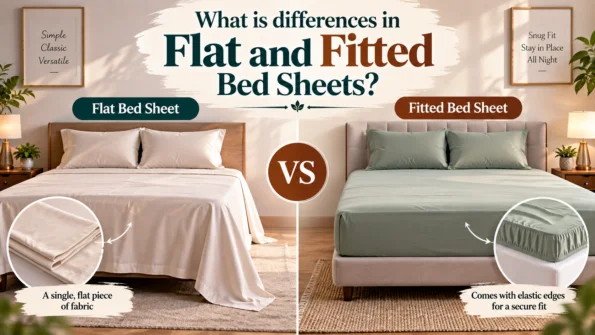
A flat sheet is a plain rectangle of cloth that you tuck under the mattress by hand. A fitted sheet has elastic sewn into the corners so it grips the mattress and stays put. Flat sheets suit any mattress depth and cost less. Fitted sheets stay smooth through the night but only work if the pocket depth matches your mattress.
Walk into any bedding shop in Pakistan and you will mostly be shown flat sheets. Both types do the same job, but how they stay in place changes which mattress they suit, how long they last, and how much work they are on wash day.
What is a flat bed sheet?
A flat sheet is a single rectangle of woven cloth with hemmed edges and nothing else. No elastic, no stitched corners, no shaping. You spread it over the mattress, pull the edges down, and tuck the excess underneath on all four sides.
This is what most people in Pakistan mean when they say chadar, and every print and fabric in the market is available in this form.
The tuck is what holds it, so the amount of spare cloth matters more than anything else. A sheet cut generously will hold on a thick mattress. One cut tight will pull free the first time someone turns over.
Because there is no shaping, the same piece of cloth fits a range of mattress depths. It works on a thin spring mattress and still works after you add a foam topper. That flexibility is why the format has survived.
Our full range of flat cotton sets is cut this way, with measurements listed in inches on every product so you can check the tuck margin before ordering.
What is a fitted bed sheet?
A fitted sheet is shaped like a shallow box, with elastic sewn around the edge or into the four corners so it stretches over the mattress and grips it. There is nothing to tuck. You pull each corner over the mattress and it holds itself.
The shaped part is called the pocket. Pocket depth is how far the sheet reaches down the side of the mattress before the elastic pulls it under. This single measurement decides whether a fitted sheet will work on your bed or not.
One with a ten inch pocket sits properly on a mattress up to about ten inches thick. Put it on a twelve inch mattress and the corners ride up and pop off within a few nights.
This is why the elasticated type cannot be bought by size name alone. Single, double and king tell you width and length, nothing about depth, and depth is where fitted sheets fail.
You can see what we stock in the elasticated range, where pocket depth is stated alongside the width and length.
Which one is more common in Pakistan?
Flat sheets are far more common here, and the gap is wider than in most countries. Local mills have produced flat cloth for decades, the prints are designed for it, and almost every set sold in the market comes in this form.
The reason is practical, not just traditional. Mattress depths vary a great deal from one house to another. A charpai has almost none, a spring mattress might be six inches, and orthopaedic foam runs eight to ten before you add a topper. Plain cloth absorbs all of that without anyone measuring. Elastic does not.
Households also move bedding between rooms when guests arrive, and plain cloth shifts between a single and a double at a pinch. An elasticated one only ever fits the size it was cut for.
Does a fitted sheet fit every mattress?
No, and this is the most common reason people give up on them. The sheet must match both the width and length of the mattress and the depth, and it is depth that usually goes wrong.
Measure the width and length in inches, then stand the tape on its end at the side to get the thickness. Measure with the topper and protector already on, because they add to the depth the sheet must cover. A foam topper adds two to four inches and some waterproof protectors another half inch.
Match that figure against the pocket depth stated on the product. Nine inch mattress with a ten inch pocket works. Nine inch mattress with a seven inch pocket does not.
If you are unsure, send your three measurements on WhatsApp to 0324 492 4274 before you order and we will tell you which size works.
Which is easier to wash and dry?
Plain cloth is easier at every stage, and the difference shows most on the line. It is a rectangle. It hangs evenly, dries at the same speed across its whole surface, and folds into a neat square without effort.
Elastic holds water longer than the rest of the cloth, so the corners stay damp after the middle has dried. In humid weather in Karachi or Hyderabad that means an extra hour or two on the line, and in monsoon it can mean a musty smell if the sheet is folded away too soon. Folding is the other complaint, since a shaped sheet will not lie flat.
Wash them in cold or warm water and dry in the shade. Hot water and full sun both shorten the life of elastic.
Which one lasts longer?
Plain cloth lasts longer on average, because they have no elastic to fail. It wears out when the cloth thins at the centre, which is slow and measured in years. An elasticated one can finish its useful life while the cloth is still good, because the elastic has stretched and stopped gripping. There is no practical repair once that happens.
This matters most for beds washed often. Children’s beds go through far more cycles, which is why the kids bedding range is worth picking for wash resistance. Guest houses and clinics run laundry hot, which is hard on elastic, so our hotel bedding is built for repeat laundering.
Which should you buy for which bed?
Match the format to how the bed is used, not to which one sounds better. Different rooms genuinely suit different answers.
For your own bed, either works. The deciding factor is whether the sheet comes loose at night. If you wake up with bare mattress showing at the corner, elastic fixes that permanently.
For children, elastic is worth the extra cost. They move a great deal in their sleep and pull plain cloth loose almost nightly.
For guest rooms, rented rooms and hostels, flat is more practical, because the mattress depth is often unknown and one piece of cloth covers almost anything. For bridal and jahez sets, flat is the tradition. Embroidered sets are made in flat form because the point is the spread of the design across the bed.
Can you use a flat and a fitted sheet together?
Yes, and this is the standard hotel arrangement. The elasticated one goes directly on the mattress, and a plain sheet lies on top of it, above the sleeper and below the quilt.
The top layer takes body oils and sweat, so the duvet cover above it needs washing far less often. This is rare in Pakistani homes, where a single piece of cloth under a razai is the norm and the quilt cover does the protecting instead. Neither is wrong.
Our sets start at Rs 1,850 with cash on delivery nationwide, and every listing states the fabric and measurements in inches. Browse single sizes or the double and king range; if what arrives is not what you expected, the seven day replacement covers it.
Frequently asked questions
What is the main difference between a flat and fitted bed sheet?
A flat sheet is a plain rectangle you tuck under the mattress, while a fitted sheet has elastic corners that grip it in place. Flat suits any mattress depth; fitted only fits the depth it was made for.
Is one better than the other?
Neither is better overall. Elastic stays smooth through the night, while plain cloth fits more mattress depths, costs less and lasts longer.
Do they fit all mattress sizes in Pakistan?
No, they must match the mattress width, length and depth. Measure the thickness with any topper already in place, then check it against the stated pocket depth.
Why does my fitted sheet keep coming off the corners?
The pocket depth is too shallow for your mattress, or the cloth has shrunk after washing. Adding a topper without sizing up is the usual cause.
Can you use a fitted sheet without a flat sheet?
Yes, and most Pakistani households do exactly that, using a quilt or razai directly on top. The layered hotel method is optional rather than necessary.
Which lasts longer, flat or fitted?
Flat sheets usually last longer because they have no elastic to fail. A fitted sheet often stops gripping while the cloth is still in good condition.
Are they harder to wash and dry?
The elastic corners hold water longer than the rest of the cloth, so they take longer to dry fully. Wash in cold or warm water and dry in the shade to protect the elastic.
Do they cost more in Pakistan?
Usually yes, because the extra stitching and elastic add to production cost and fewer are made locally. The price gap narrows on plain colours.