


You have seen the label “Egyptian cotton” on bed sheets dozens of times. It sounds premium. It costs more. But is the difference real — or is it mostly clever marketing?
The answer is: the difference is genuinely real, it starts at the fiber level, and it shows up in ways you can feel every single night. But Egyptian cotton is not always the right choice for every household or every budget. And regular cotton is far from a compromise.
This guide explains exactly what sets the two apart — not just scientifically, but in terms of what you will actually experience sleeping on them, washing them, and replacing them over time.
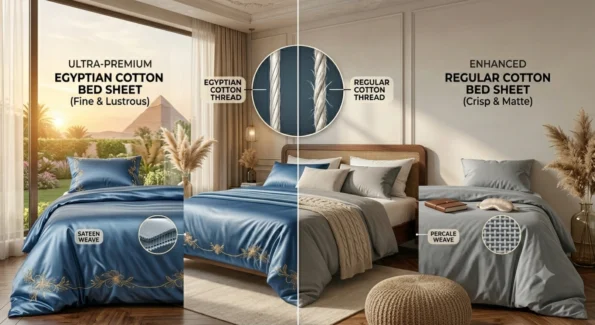
What Is Regular Cotton?
Regular cotton — most commonly Upland cotton (Gossypium hirsutum) — makes up approximately 90% of all cotton grown worldwide. It is harvested by machine in large quantities, processed efficiently, and used across the full spectrum of bedding products at every price point.
The fiber length of regular cotton typically falls between 22mm and 28mm. These shorter fibers produce a functional, comfortable, and widely available fabric that has served households around the world for centuries.
Regular cotton bed sheets are soft, breathable, easy to care for, and available in an enormous range of styles, colours, and weaves. For most everyday purposes, they perform well.
What Is Egyptian Cotton?
Egyptian cotton (Gossypium Barbadense) grows exclusively in Egypt’s Nile Delta, where the unique combination of fertile soil, a consistent water supply from ancient irrigation systems, and a specific climate produces cotton fibers of exceptional length and fineness.
Egyptian cotton is classified as an extra-long staple (ELS) cotton. Its fibers typically measure 34mm or longer — significantly longer than those of regular cotton. These fibers are also finer in diameter, which means they can be spun into a smoother, more uniform yarn.
Traditionally, Egyptian cotton is hand-picked rather than machine-harvested. This preserves the integrity of the long fibers, preventing stress damage that machine harvesting causes to shorter-staple cotton.
The Core Difference: Fiber Length and What It Means
The fundamental difference between Egyptian cotton and regular cotton comes down to fiber length. This single factor drives every other difference you will encounter.
Here is why fiber length matters so much:
Longer fibers = smoother yarn. When long fibers are spun into yarn, fewer fiber ends are exposed on the surface of the thread. Fewer exposed ends means a smoother, silkier surface against your skin.
Longer fibers = stronger fabric. More fiber length means more overlap between fibers in the yarn, which creates a stronger bond. This is why Egyptian cotton resists pilling and tearing for far longer than regular cotton.
Longer fibers = better dye absorption. Egyptian cotton’s more porous fiber structure absorbs color more deeply and evenly. This is why Egyptian cotton bed sheets maintain their color and vibrancy through years of washing, while regular cotton often fades noticeably within the first year.
Longer fibers = sheets that improve with age. This is the most surprising quality of Egyptian cotton — and the one that most clearly separates it from regular cotton. Egyptian cotton fibers “bloom” with washing. The sheets become noticeably softer and more comfortable the more you wash them. Regular cotton can soften slightly but generally deteriorates rather than improves over time.
Side-by-Side Comparison: Egyptian Cotton vs Regular Cotton Bed Sheets
| Feature | Egyptian Cotton | Regular Cotton |
|---|---|---|
| Fiber length | Extra-long staple (34mm+) | Short to medium staple (22–28mm) |
| Surface feel | Silky smooth, minimal friction | Comfortable but slightly textured |
| Breathability | Excellent | Good |
| Moisture wicking | Superior | Moderate to good |
| Durability | 10+ years with proper care | 2–4 years average |
| Pilling resistance | High — very little pilling | Moderate — pilling increases over time |
| Color retention | Excellent — deep, lasting color | Good initially, fades faster |
| Improves with washing | Yes — gets softer over time | Minimal improvement |
| Price | Higher investment | Accessible at all budgets |
| Care requirements | Gentle cycle, cool water preferred | Standard machine wash |
How They Feel Differently in Real Life
This is the part most guides skip. Knowing that Egyptian cotton has longer fibers is useful, but knowing how that difference actually translates into your nightly experience is more useful.
Night one: Egyptian cotton feels noticeably cooler and smoother against the skin than regular cotton of a similar weight. The texture is closer to a fine hotel sheet — structured but silky. Regular cotton feels soft and comfortable, but there is a slight texture that is absent in Egyptian cotton.
After six months: Egyptian cotton has softened further and now feels even more comfortable than it did when new. Regular cotton still feels fine, though the texture may have roughened slightly and some pilling may have appeared at points of friction.
After two years: A quality set of Egyptian cotton bed sheets still feels genuinely luxurious. The color has held. The weave is intact. A regular cotton set of equivalent original quality may have thinned noticeably, with color fading and pilling at corners and edges.
After five years: Egyptian cotton sheets, properly cared for, are still in rotation and have softened to an exceptional degree. Most regular cotton sets from the same purchase period have been replaced at least once.
This trajectory is why Egyptian cotton is consistently described as an investment rather than a purchase. The higher upfront cost distributes across a much longer lifespan.
Breathability and Temperature: Which Is Better for Pakistan?
Both cotton types are natural and breathable. But there are meaningful differences for Pakistani sleepers, where temperatures regularly exceed 40°C in summer and winters can be cold in northern regions.
Egyptian cotton’s finer, more open fiber structure allows air to circulate slightly more effectively than regular cotton of a similar weave. It is also more moisture-wicking — pulling sweat away from the skin more efficiently — which is a genuine benefit during Pakistan’s humid summer nights.
For hot sleepers and for use during Pakistani summers, Egyptian cotton bed sheets in a percale weave are one of the most effective natural bedding options available.
Regular cotton percale also performs well in summer — it is breathable and moisture-absorbing — but Egyptian cotton maintains those properties more consistently as it ages, while regular cotton’s breathability can decrease as the weave wears.
For winter use, both Egyptian cotton sateen and regular cotton sateen provide adequate warmth, though Egyptian cotton’s superior durability means the weave retains its insulating properties for longer.
The Thread Count Question
Thread count is particularly misunderstood when it comes to Egyptian cotton.
Because Egyptian cotton fibers are longer and finer, they can be woven at higher thread counts without sacrificing breathability. A 400 thread count Egyptian cotton sheet breathes better than a 400 thread count regular cotton sheet, because the finer fibers create a denser yet still open weave.
This also means that Egyptian cotton bed sheets perform optimally in a different thread count range than regular cotton:
- Regular cotton: 200–400 thread count is the sweet spot for breathability and durability
- Egyptian cotton: 300–600 thread count delivers the best balance of softness, breathability, and longevity
Above 600 thread count in either type, quality improvements become marginal. Very high thread counts — 800, 1000, or above — in Egyptian cotton often use multi-ply yarns that inflate the number without adding genuine quality.
How to Tell If Egyptian Cotton Is Genuine
Because “Egyptian cotton” commands a premium, the label is frequently misused. Some products labelled as Egyptian cotton use short-staple fibers grown outside Egypt, blended fibers, or use the term loosely without certification.
What to look for:
- The Cotton Egypt Association (CEA) Gold Seal of authenticity — this is the industry standard for verified Egyptian cotton
- Specific Giza variety names on the label (Giza 45 and Giza 87 are the finest grades)
- Price realism — authentic Egyptian cotton bed sheets at a full queen or king size will not be extremely cheap. If the price seems too good to be true, it likely is not genuine ELS Egyptian cotton
- Single-ply yarn construction — multi-ply yarns are often used to inflate thread counts without improving quality
If none of these certifications or details appear on a product labelled “Egyptian cotton,” treat the claim with caution.
Which Should You Choose?
The honest answer depends on three things: your budget, your sleep priorities, and how long you want your bed sheets to last.
Choose Egyptian cotton bed sheets if:
- You want the softest, smoothest sleeping surface available in natural cotton
- You are making a long-term investment and want bed sheets that last a decade or more
- You are a hot sleeper who wants superior moisture-wicking and breathability
- You are furnishing a master bedroom or guest room where quality and first impressions matter
Choose regular cotton bed sheets if:
- Your budget does not currently extend to Egyptian cotton
- You are furnishing a children’s room, where frequent washing and durability under rough use matter more than luxury feel
- You prefer to rotate between many styles and colors regularly — regular cotton’s lower price makes this more practical
- You want a reliable, comfortable everyday option without a premium investment
Both are natural. Both breathe. Both are suitable for Pakistan’s climate. The difference is in degree — and in how long that quality lasts.
Explore the full range of bed sheets at bedsheet.com.pk — including cotton options across different styles, weaves, and price points to suit every bedroom and budget.
Caring for Egyptian Cotton vs Regular Cotton
Proper care significantly extends the life of both types — but Egyptian cotton rewards careful washing more than regular cotton does.
For Egyptian cotton bed sheets:
- Wash on a gentle or cool cycle — hot water weakens even long-staple fibers over time
- Use a mild, gentle detergent — harsh chemicals strip the natural properties from the fiber
- Avoid fabric softeners — Egyptian cotton softens naturally with washing; softeners coat the fibers and reduce breathability
- Tumble dry on the lowest heat setting or air dry in the shade
- Iron while slightly damp on a medium heat setting if needed
For regular cotton bed sheets:
- Machine wash on a standard cycle in warm water
- Use a regular detergent appropriate for cotton
- Tumble dry on low to medium heat
- Iron while damp for the best finish
- Wash every 7 to 10 days for freshness — more frequently in summer
Frequently Asked Questions
Is Egyptian cotton really better than regular cotton for bed sheets?
Yes — in measurable, real-world ways. Egyptian cotton’s extra-long staple fibers produce a smoother, softer, and significantly more durable fabric than regular cotton. The sheets also improve with washing rather than deteriorating. The main consideration is price — Egyptian cotton costs more upfront, though its longer lifespan often makes the cost per use comparable or lower.
How long do Egyptian cotton bed sheets last compared to regular cotton?
With proper care, high-quality Egyptian cotton bed sheets can last 10 years or more. Regular cotton bed sheets typically last 2 to 4 years before noticeable deterioration — pilling, thinning, and color fading — occurs. This lifespan difference is the primary reason Egyptian cotton is considered an investment rather than an expense.
What thread count should I look for in Egyptian cotton bed sheets?
A thread count between 300 and 600 in single-ply construction is the optimal range for Egyptian cotton. Within this range, breathability, softness, and durability are all at their peak. Above 600, improvements are minimal and high thread counts often indicate multi-ply yarn construction that inflates the number without adding genuine quality.
Can I tell the difference between Egyptian and regular cotton just by touching?
Yes — on genuine, high-quality Egyptian cotton. The surface is noticeably smoother and cooler to the touch than regular cotton of similar weight. The difference is most apparent in the first few seconds of contact and in how the fabric drapes. Lower-quality or blended “Egyptian cotton” products may feel little different from standard cotton, which is why certification matters.
Are Egyptian cotton bed sheets suitable for Pakistan’s summer climate?
Yes. Egyptian cotton’s finer fiber structure makes it highly breathable and moisture-wicking — both essential qualities for Pakistan’s hot and humid summers. In a percale weave at a thread count of 300 to 400, Egyptian cotton bed sheets are among the most comfortable natural bedding options for warm weather sleeping.
What is the difference between Egyptian cotton and Pima cotton?
Both are extra-long staple (ELS) cottons and are considered premium varieties. Egyptian cotton grows in Egypt’s Nile Delta, while Pima (also known as Supima) cotton grows primarily in the American Southwest. Both produce a similarly soft, durable fabric. Egyptian cotton is more widely marketed; Pima cotton is equally high quality and often slightly more accessible in price.
Final Thoughts
The difference between Egyptian cotton and regular cotton bed sheets is real, meaningful, and worth understanding before you buy.
Regular cotton bed sheets are a reliable, comfortable, and practical choice for everyday use — particularly for families, children’s rooms, and households that prefer to rotate bedding regularly. They perform well, wash easily, and are available across every price range.
Egyptian cotton bed sheets are a genuinely different experience. Softer from the first night, increasingly comfortable with every wash, more breathable in summer, more durable across the years. If you are making a long-term investment in your bedroom — particularly for a master bedroom or guest room where quality matters — Egyptian cotton is worth every rupee.
The best bed sheets are not always the most expensive ones. They are the ones that match your sleeping needs, your bedroom priorities, and your budget — and last long enough to justify the investment.
Browse the full collection of cotton bed sheets and find the right fabric and style for every bed in your home.